
 Calendar
 I Love This Place
 Blogs
Blogs Venues
 Downtown
 Experiences
 Residents
 Shop
Shop Visitors


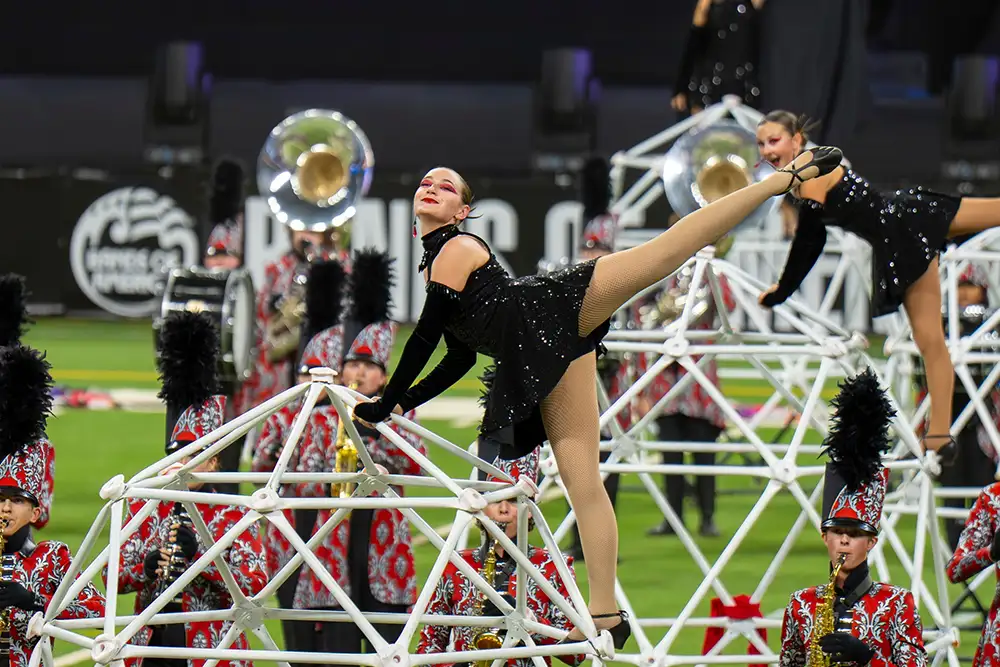
The Dobyns-Bennett Band traces its beginning to 1926, when Professor S.T. “Fess” Witt organized the first school band and helped launch what would become one of Kingsport’s proudest traditions. By the fall of 1940, the band was already growing in size, visibility, and community support. Fourteen years after its founding, Dobyns-Bennett added a new visual element: eight “flag swingers,” the earliest documented forerunners of today’s color guard.
A September 12, 1940, Kingsport Times article captured the excitement. The city was about to get its first glimpse of the band’s new uniforms during a pre-game parade before Dobyns-Bennett played Virginia High of Bristol. The article noted that the band had grown to approximately 95 players, supported by two drum majors, two majorettes, eight flag swingers, and four “girl sponsors,” a period term for young women who often held roles without playing instrumental music.
The new uniforms were a major civic investment. Valued at $3,400, they were purchased with funds donated by the Hammond Post of the American Legion. They included gray trousers with maroon side stripes, maroon coats trimmed in gray, American Legion emblems on the lapels, and West Point-style hats with white plumes. The band was becoming more than a school activity. It was becoming a community ambassador.
The 1941 Maroon and Grey yearbook gave special attention to the new flag swingers. It described “eight girls who waved brightly colored flags while the two majorettes danced and twirled their batons to the delight of the fans.” The yearbook also noted that by practicing with the band during the summer months, they “soon became expert flag swingers, adding much color to the band and helping its general appearance.”
That simple description marks an important beginning. The first Dobyns-Bennett flag swingers helped define the band’s emerging visual identity. While the musicians carried the sound, the flag swingers carried color, movement, and precision.
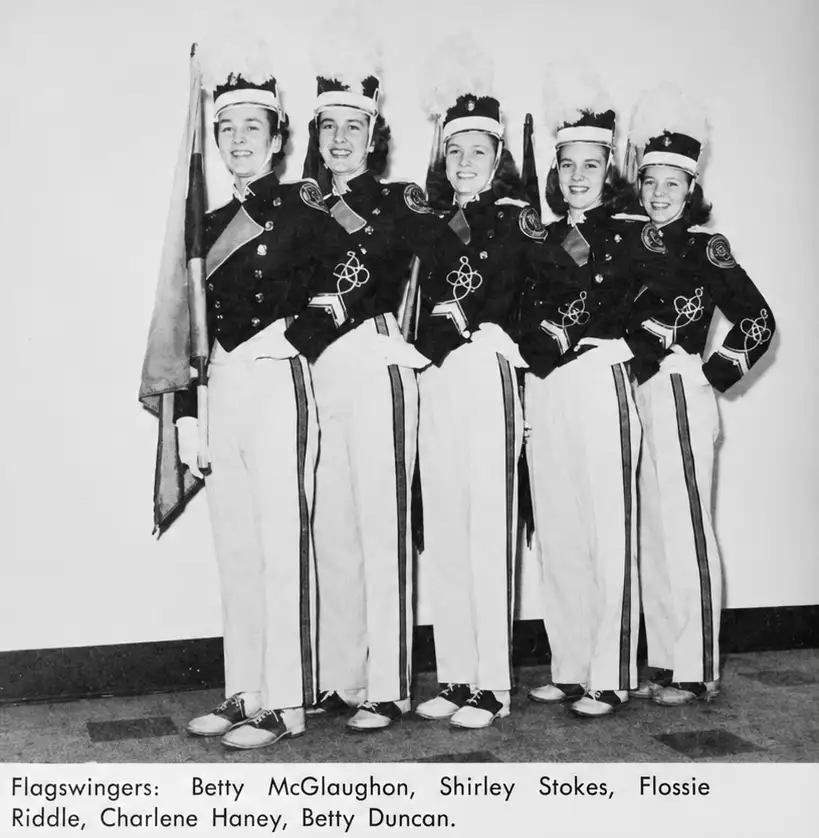
The 1949–50 Flagswingers (pictured) show the military-style roots of the Color Guard during the post World War II era.
Over the decades, that early visual tradition grew into something far more sophisticated. The modern Dobyns-Bennett Color Guard became an integral part of one of the nation’s most respected high school band programs. As the marching band earned national recognition through Bands of America competition, the visual program grew alongside it, becoming essential to the full Dobyns-Bennett performance identity.
The Dobyns-Bennett Winter Guard has now written its own remarkable chapter. In 2023, the program won the Winter Guard International (WGI) Scholastic A World Championship, bringing a world title home to Kingsport with a score of 98.95. In WGI, “Scholastic” refers to school-based guards, while A, Open, and World represent progressively higher levels of experience, design, skill, and competitive demand.
That makes D-B’s progression especially impressive. After winning Scholastic A, the program moved into the more demanding Scholastic Open class and quickly proved it belonged. In 2024, Dobyns-Bennett made Scholastic Open Class finals for the first time in program history and finished tenth. In 2025, the program continued building strength in Scholastic Open, earning recognition as the WGI Charlotte Scholastic Open Class Champion and the Carolina Winter Ensemble Association Scholastic Open Class Champion.
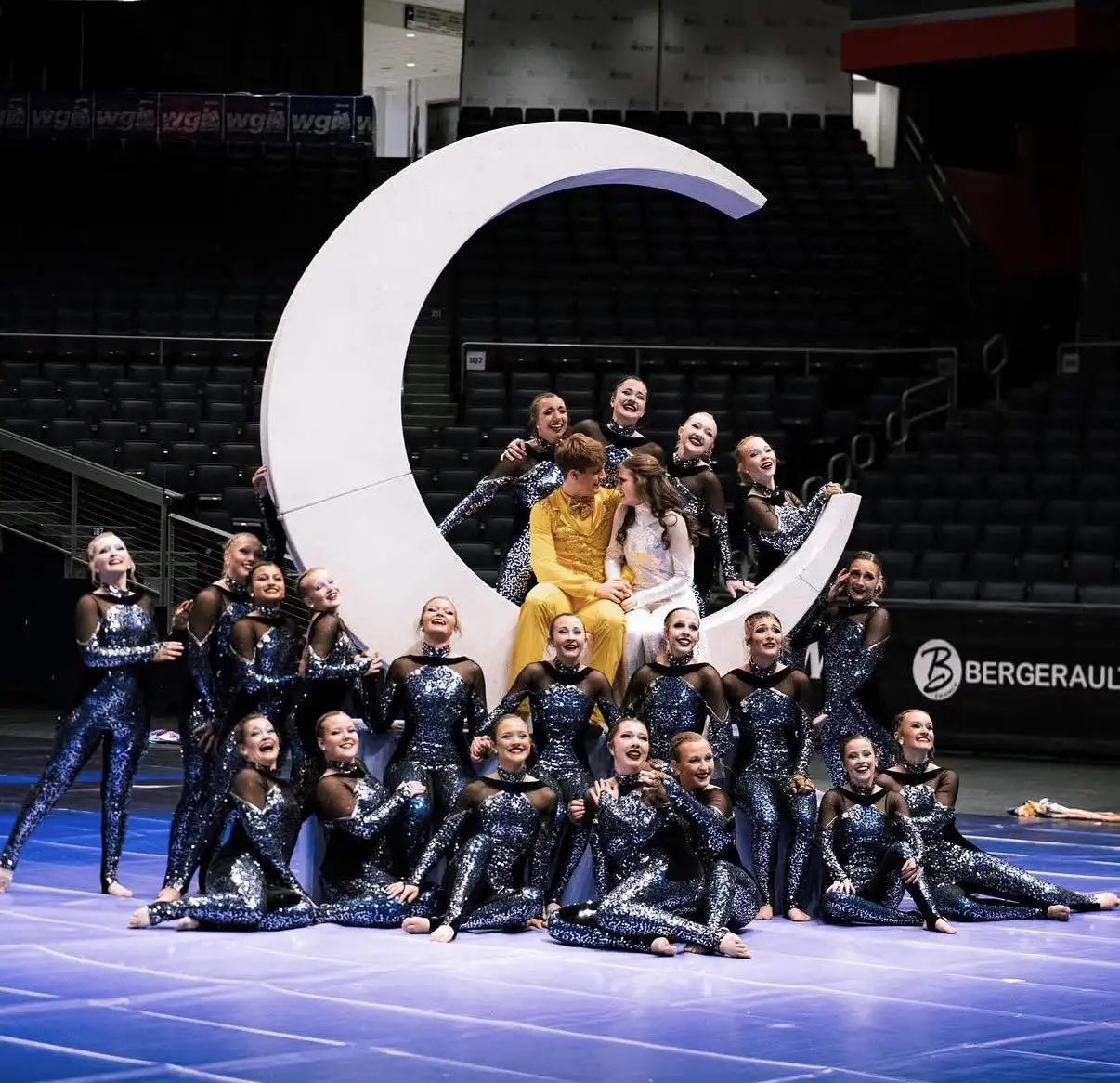
The momentum continued in 2026, when D-B’s production, The Tale of the Sun and the Moon, reached the WGI Scholastic Open World Championship Finals and finished sixth with a score of 93.200. Dobyns-Bennett did not simply win at one level and stop. It advanced into a stronger competitive arena and proved it belonged.
The scale of the program has changed dramatically. The original 1940-41 unit included just eight “flag swingers.” For the 2026 Dobyns-Bennett Color Guard, 98 students auditioned, and 70 earned spots on the roster. Today’s guard is nearly nine times larger than the original group of eight.
The language has changed. The equipment, choreography, staging, and expectations have changed. But the purpose remains familiar: to turn music into motion, sound into sight, and school spirit into something an audience can feel.
In 1941, those first Dobyns-Bennett flag swingers appeared in the yearbook as a colorful new addition to the band. More than eighty years later, today’s performers have carried that color all the way to the highest levels of national and international competition — one more chapter in a century-long story of excellence, tradition, and Kingsport Spirit.
From Flag Swingers to World Champions: Dobyns-Bennett’s Color Guard Tradition
By Jeff Fleming - Contributor
May 17, 2026
The Dobyns-Bennett Band traces its beginning to 1926, when Professor S.T. “Fess” Witt organized the first school band and helped launch what would become one of Kingsport’s proudest traditions. By the fall of 1940, the band was already growing in size, visibility, and community support. Fourteen years after its founding, Dobyns-Bennett added a new visual element: eight “flag swingers,” the earliest documented forerunners of today’s color guard.
A September 12, 1940, Kingsport Times article captured the excitement. The city was about to get its first glimpse of the band’s new uniforms during a pre-game parade before Dobyns-Bennett played Virginia High of Bristol. The article noted that the band had grown to approximately 95 players, supported by two drum majors, two majorettes, eight flag swingers, and four “girl sponsors,” a period term for young women who often held roles without playing instrumental music.
The new uniforms were a major civic investment. Valued at $3,400, they were purchased with funds donated by the Hammond Post of the American Legion. They included gray trousers with maroon side stripes, maroon coats trimmed in gray, American Legion emblems on the lapels, and West Point-style hats with white plumes. The band was becoming more than a school activity. It was becoming a community ambassador.
The 1941 Maroon and Grey yearbook gave special attention to the new flag swingers. It described “eight girls who waved brightly colored flags while the two majorettes danced and twirled their batons to the delight of the fans.” The yearbook also noted that by practicing with the band during the summer months, they “soon became expert flag swingers, adding much color to the band and helping its general appearance.”
That simple description marks an important beginning. The first Dobyns-Bennett flag swingers helped define the band’s emerging visual identity. While the musicians carried the sound, the flag swingers carried color, movement, and precision.
The 1949–50 Flagswingers (pictured) show the military-style roots of the Color Guard during the post World War II era.
Over the decades, that early visual tradition grew into something far more sophisticated. The modern Dobyns-Bennett Color Guard became an integral part of one of the nation’s most respected high school band programs. As the marching band earned national recognition through Bands of America competition, the visual program grew alongside it, becoming essential to the full Dobyns-Bennett performance identity.
The Dobyns-Bennett Winter Guard has now written its own remarkable chapter. In 2023, the program won the Winter Guard International (WGI) Scholastic A World Championship, bringing a world title home to Kingsport with a score of 98.95. In WGI, “Scholastic” refers to school-based guards, while A, Open, and World represent progressively higher levels of experience, design, skill, and competitive demand.
That makes D-B’s progression especially impressive. After winning Scholastic A, the program moved into the more demanding Scholastic Open class and quickly proved it belonged. In 2024, Dobyns-Bennett made Scholastic Open Class finals for the first time in program history and finished tenth. In 2025, the program continued building strength in Scholastic Open, earning recognition as the WGI Charlotte Scholastic Open Class Champion and the Carolina Winter Ensemble Association Scholastic Open Class Champion.
The momentum continued in 2026, when D-B’s production, The Tale of the Sun and the Moon, reached the WGI Scholastic Open World Championship Finals and finished sixth with a score of 93.200. Dobyns-Bennett did not simply win at one level and stop. It advanced into a stronger competitive arena and proved it belonged.
The scale of the program has changed dramatically. The original 1940-41 unit included just eight “flag swingers.” For the 2026 Dobyns-Bennett Color Guard, 98 students auditioned, and 70 earned spots on the roster. Today’s guard is nearly nine times larger than the original group of eight.
The language has changed. The equipment, choreography, staging, and expectations have changed. But the purpose remains familiar: to turn music into motion, sound into sight, and school spirit into something an audience can feel.
In 1941, those first Dobyns-Bennett flag swingers appeared in the yearbook as a colorful new addition to the band. More than eighty years later, today’s performers have carried that color all the way to the highest levels of national and international competition — one more chapter in a century-long story of excellence, tradition, and Kingsport Spirit.